Sovren · Creator payouts · Shipped 2026
How I built a creator payout that doubled as user acquisition.
Creators earn a share of the ad revenue the people they bring in drive, three degrees out. It sounded like an MLM to a creator, so I sold it to agencies as a network. That became the platform's primary user acquisition strategy.
Creators had no way to earn, and the standard models pay on the wrong number.
Before memberships, a creator couldn't make money on the platform. The two models I could copy both bothered me. Pay on followers and you're paying for a number that lives on someone else's platform. Pay a bounty per signup and you're paying for accounts that can be bought, and bought accounts are gone in a week or two. Either way I'd be buying a spike.
The creators we could actually get were micro and niche. A few hundred to a few thousand people who show up for them specifically, and no follower count the big platforms would pay out on. The model had to work for that creator on day one.
A share of the ad revenue your network drives: 5, 3 and 2 percent, three degrees out, from the first invite.
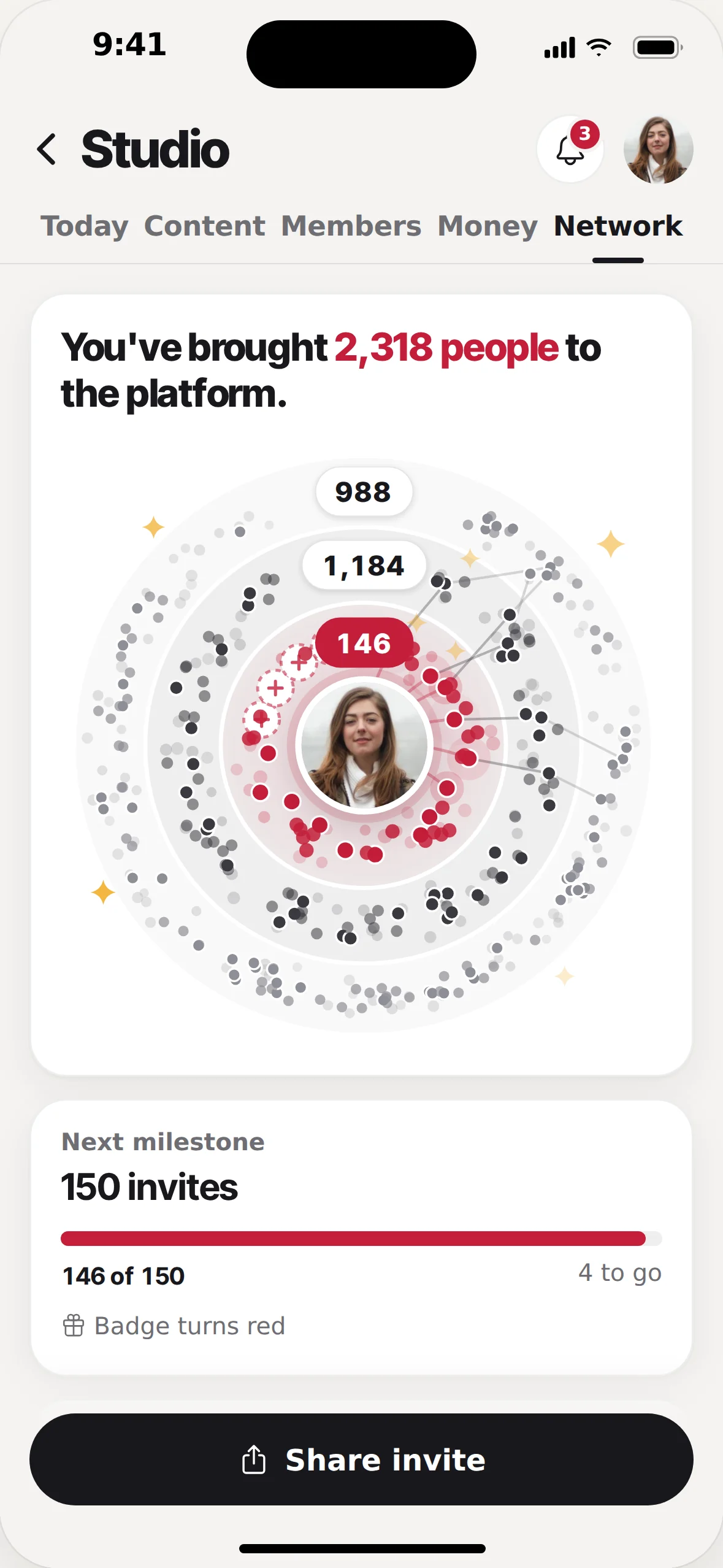
When you bring someone to the platform, you earn on the ad revenue their activity drives. 5% on the people you bring in directly. 3% on the people they bring in. 2% one more step out. No threshold. Your first invite starts earning, and it keeps paying as long as those people keep showing up.
That's the whole idea. The money follows people who arrived, stayed, and did things. An account that does nothing drives nothing and pays nobody. Direct invites are the only ones that count toward a milestone, so nobody hits a goal off a network they didn't build.
10% of the ad revenue your own posts drive, out of the same money.
Creators also earned on their own content, because we needed people posting. This is where creator payouts usually go wrong. Pay for engagement and the fastest way to earn is to be loud. Outrage is the cheapest engagement there is, and a platform that pays for it is paying people to start fights.
So content earning came out of the same ad revenue. A post that spikes reactions from drive-by accounts drives almost nothing. A post that brings in someone who comes back keeps earning. The most profitable thing a creator could do was build real connection, because that's what I wanted the platform to be.
It sounded like an MLM, and a creator gives you ten seconds.
Earn on the people you bring in, and the people they bring in. Say that to a creator and they hear a pyramid. We assumed that's how it would land, and it did. A creator gives you about ten seconds to understand an offer, and ours needed a diagram. We couldn't pitch creators.
- Situation
- The structure was right and the pitch was wrong. Three degrees of revenue share is the exact shape of a multi-level marketing offer.
- Call
- Stop pitching creators. Pitch the agencies that already represent them.
- Cost
- A model that still needs explaining to anyone who meets it cold.
Ten minutes with an agency, pitched as a network. Distribution and acquisition in one.
An agency will give you ten minutes, and an agency already manages a network of creators for a living. So I pitched it in those terms. Your roster is your direct ring. Their audiences are your second and third. You earn on all of it. Framed as a network, the same structure that sounded like a pyramid to a creator sounded like a normal commercial term to an agency, and they signed it.
That gave us two things at once:
- Distribution. One agency conversation put the model in front of hundreds of creators, explained by someone they already trusted.
- Acquisition. The agency became our top of funnel. Every creator in the roster lands as the agency's direct network, already inside the model, and the agency earns on all of them, so it has a reason to keep them posting.
Behavior variance against organic signups, and no share until the creator verified identity.
Paying on ad revenue was the first check against farmed accounts, since an account that does nothing drives nothing. But a farm can scroll. So I watched two things.
Retention. Bought signups spiked and fell off inside days, sometimes weeks. Invited cohorts held.
Then the shape of the activity. Farmed accounts did one or two things over and over. Views and reactions. Hundreds of sessions a day, each under a minute and all the same length. Or the same comment on everything. Organic signups did a little of everything, in fewer, longer sessions that moved around.
So we built a meter that scored how varied an account's behavior was against the organic cohort. A creator whose network scored low got flagged, got an automated message asking them to verify identity, and came out of the share until they did. Verified, they went back in.
The platform's primary user acquisition strategy.
This started as the first way a creator could earn and became how the platform grew. Every creator who earned was recruiting. Every agency brought a roster that recruited underneath it. Acquisition spend went to people already on the platform, as a share of what their network drove.
A few agencies brought their rosters, hundreds of creators. Not A-tier names. Micro and niche, which is who the model was built for.
The model, the shares, the content rule, the agency pitch, the meter definition.
Mine
- The decision to pay on ad revenue and on nothing a creator could buy.
- The three degrees, the 5 / 3 / 2 shares, and the day-one rule.
- Content earning on the same money.
- The switch to agencies, and pitching it as a network.
- What the authenticity meter measured, and what a low score set off.
- The scoring pipeline engineering built from the meter definition.
Not mine
- The attribution and tracking build.
- The contract language in the agency agreements.
Scale, depth, and what happens with a bigger agency.
A few agencies isn't a market. It proves the pitch lands with an agency. It doesn't prove it lands at scale, or that three degrees is still the right depth once the third degree is strangers.
The meter is a heuristic. Variety of behavior separated a farm from a person at our scale. A motivated farm could learn to wander, and I never had enough pressure on it to find out how fast.
I never ran it against an A-tier roster, so I don't know what happens when the agency at the top is big enough to argue the terms.
The number I'd want first somewhere bigger: revenue per invited user at 90 days, against organic, by degree.